Strength Training Over 50: What Actually Matters
Getting older doesn’t mean your training needs to become timid.
It needs to become smarter.
I work with a lot of people in their 40s, 50s, 60s and beyond, and one of the biggest mistakes I see is the assumption that strength training needs to fundamentally change once you hit a certain birthday.
Suddenly everything is supposed to be lighter. Slower. Easier. Safer.
Don’t lift too much.
Don’t move too fast.
Don’t do anything that looks remotely athletic.
I don’t agree.
Your body still needs a reason to stay strong.
What does change as we get older is that there is less room for training that has no purpose. Poor exercise selection, unnecessary volume, inadequate recovery and workouts designed primarily to make you exhausted become harder to get away with.
That’s why I don’t think the question is:
“How should someone over 50 exercise?”
A much better question is:
“What does this person need their body to be able to do—and how do we train for that?”
That’s where good coaching starts.
Muscle Matters. But So Does What You Can Do With It.
There’s good reason strength training gets more attention as we age.
Maintaining muscle and strength becomes increasingly important for preserving physical function, metabolic health, bone health and independence. But I think the conversation sometimes gets reduced to:
You’re getting older. You’re losing muscle. Go lift weights.
Technically useful advice. Practically incomplete.
I don't just want someone to have more muscle on their body.
I want that muscle to do something.
Can you get yourself off the floor?
Can you carry something heavy?
Can you climb stairs without thinking about it?
Can you hike, ski, surf, play pickleball or chase your grandkids?
Can you catch yourself when you stumble?
Can you put your suitcase in the overhead compartment without wondering whether your shoulder is going to survive the experience?
Those are expressions of physical capacity.
And that’s ultimately what we’re trying to preserve—and ideally improve—as we age.
You’re Not Training for Your Age. You’re Training for Your Life.
Two 55-year-olds can walk into my studio and need completely different programs.
One may have been exercising consistently for 30 years.
The other may not have trained since college.
One may want to continue skiing aggressively into their 70s.
The other may simply want to get up and down from the floor comfortably and stop feeling weak carrying groceries.
One may recover beautifully from three or four challenging workouts each week.
The other may have a demanding job, poor sleep, significant stress and a history of injuries that changes what they can currently tolerate.
They're the same age.
They shouldn't have the same program.
This is one of the reasons I don't put much value in generic workouts labeled “for people over 50.”
Age matters.
But so do your training history, movement capabilities, injuries, health, lifestyle, goals and ability to recover.
The program should serve the person.
The person shouldn't have to serve the program.
The Three Questions I Ask About Training
Most of my programming decisions eventually come back to three questions:
1. Can you express it?
Before I add more weight, more repetitions, more speed or more complexity, I want to know whether you can actually perform the movement well.
That doesn't mean everyone needs textbook-perfect movement.
Human beings are built differently.
It means you need enough control, mobility, stability and coordination to express the movement appropriately for your body.
If you can't, simply loading it harder isn't necessarily progress.
Sometimes the fastest way forward is improving the thing underneath the thing you're trying to improve.
2. Can you recover from it?
This becomes increasingly important as life gets more complicated.
Your workout doesn't exist in isolation.
Sleep matters.
Nutrition matters.
Work stress matters.
Your health matters.
What you did yesterday matters.
What you're doing tomorrow matters.
A workout can look fantastic on paper and still be completely inappropriate for the person doing it.
If Monday's workout destroys you until Thursday, I don't automatically consider Monday a success.
Training creates stress. Your body adapts to that stress during recovery.
We need enough stimulus to create adaptation without continually exceeding your ability to recover from it.
That's a moving target—which is one reason good programming should evolve with you.
3. Does it serve a purpose?
This might be my favorite question.
Why are we doing this exercise?
Why this many sets?
Why this much weight?
Why this conditioning piece?
Why today?
There should be an answer.
Nothing is added just to make you tired.
Sweating more doesn't automatically mean you had a better workout. Being sore for three days isn't a medal. And collapsing on the floor afterward isn't evidence that the program is working.
Sometimes training should be hard.
But hard and effective aren't synonyms.
Strength Isn't the Only Thing Worth Preserving
Strength is obviously central to what I do.
But a capable human body needs more than strength.
As we age, I want to preserve—and when possible improve—a combination of qualities:
Strength. Muscle. Power. Balance. Coordination. Mobility. Cardiovascular capacity. Work capacity.
Power deserves particular attention.
Strength is your ability to produce force. Power involves producing force quickly.
Think about catching yourself when you trip.
Standing up quickly.
Reacting to something unexpected.
Moving athletically.
We tend to stop doing fast things as we age, and then act surprised when we become less capable of moving quickly.
That doesn't mean everybody over 50 should start doing box jumps tomorrow.
It means speed and power can be trained intelligently at an appropriate level instead of simply being abandoned.
The same applies to balance and coordination.
The goal isn't to turn every workout into a circus act on an unstable surface.
The goal is to maintain a body that can interact confidently with the real world.
What About Old Injuries?
This is another place where people often get stuck.
They hurt a knee 15 years ago, so they stopped squatting.
Their shoulder bothered them, so they stopped pressing.
Their back hurt once while deadlifting, so they've spent the last decade avoiding anything that resembles picking something heavy off the ground.
Sometimes temporary restrictions are absolutely appropriate.
But there's an important difference between working around something while rebuilding capacity and deciding that part of your body is permanently off-limits.
This is where assessment matters.
What can you currently do?
What can't you do?
What produces symptoms?
What movement options do you have?
What can we train safely while we improve the things that need attention?
The answer isn't always to stop.
Sometimes it's to change the exercise, range of motion, load, volume or progression.
Start where you are. Then build from there.
Recovery Is Part of the Program
One of the biggest changes I make when coaching someone over 50 isn't necessarily the exercises.
It's paying closer attention to what happens between workouts.
You don't get stronger simply because you trained.
Training provides the stimulus.
Your body still has to adapt to it.
That makes adequate nutrition, protein, sleep, hydration and stress management part of the conversation—not extras we talk about after the “real” training is finished.
This doesn't mean your life has to revolve around optimizing recovery.
Quite the opposite.
Your training needs to fit inside your actual life.
If you're sleeping five hours a night, working 60 hours a week and caring for an aging parent, I shouldn't program you as though you're a professional athlete whose afternoon plans include a nap and a massage.
That's not lowering expectations.
That's coaching the person standing in front of me.
How Often Should You Strength Train After 50?
There isn't one correct number.
For many people, two or three well-designed strength sessions per week can accomplish a tremendous amount.
Others may appropriately train more frequently.
The right frequency depends on what you're training for, how much work you're doing in each session, what else you do physically and how well you're recovering.
Consistency matters far more to me than creating an impressive-looking weekly schedule that you can't sustain.
I'd rather have someone train intelligently twice a week for the next ten years than train five days a week for six weeks and quit.
You Don't Need to Train Like You're 25.
You Also Don't Need to Train Like You're 85.
This is the middle ground I think gets missed.
Getting older isn't a reason to stop challenging yourself.
It's a reason to become more thoughtful about how you're challenging yourself.
Train hard enough to give your body a reason to adapt.
Recover well enough to allow that adaptation to happen.
Choose exercises and training methods that support what you actually want your body to be capable of doing.
Then keep progressing.
Because the goal isn't just to be someone who exercises.
The goal is to build and maintain a body that lets you participate in your life.
Start With What Your Body Can Do Today
At Regenerate Strength, I don't begin by deciding which program someone needs.
I begin by assessing the person.
We look at your goals, training history, movement, current capabilities and work capacity. We also use an InBody body-composition assessment to give us another piece of the picture.
Then we decide what makes sense.
For some people, that's hands-on training in my private San Roque studio. For others, it's in-home training, a structured 12-week Jump Start, or Remote Coaching.
The level of support depends on the person.
The principle doesn't change:
Can you express it?
Can you recover from it?
Does it serve a purpose?
If the answer is yes, we're probably moving in the right direction.
Because after 50, the objective isn't simply to keep exercising.
It's to keep building the strength and capacity to do the things you want to do—for as long as possible.
Build strength for the life you want to live.
Not Sure Where Your Training Should Start?
You don't need to figure that out before we talk. We'll start with where you are, what you want your body to be able to do, and what kind of support actually makes sense for you.
BOOK A FREE DISCOVERY CALL
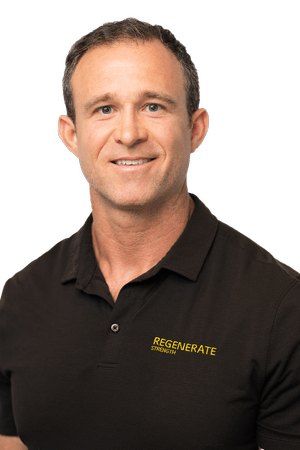
Coach Dave Downey
Regenerate Strength | Santa Barbara, CA