Why Your Fitness Program Should Start With an Assessment, Not a Workout
Most people start a fitness program by working out.
That seems logical.
You decide you want to get stronger, lose some weight, improve your health or get back in shape, so you join a gym, download a program, sign up for a class or hire a trainer.
And then you start exercising.
But there's a problem.
Nobody has actually figured out where you're starting.
Before I decide what exercises you should do, how heavy you should lift, how often you should train or what your program should look like, I need to understand the person I'm programming for.
What are you trying to accomplish?
What can your body currently do?
What have you done before?
What injuries or limitations do we need to consider?
What does your lifestyle look like?
How well do you recover?
How much physical work can you currently tolerate?
And perhaps most importantly:
What do you actually want your body to be able to do?
That's why at Regenerate Strength, the workout isn't Step One.
The Assessment is.
A Program Is Only as Individualized as the Information Behind It
“Personalized fitness” gets thrown around a lot.
Change a few exercises.
Adjust the weights.
Put someone's name at the top of a workout.
Technically, I suppose that's personalization.
But if I want to build a program specifically for you, I need more information than that.
Two people can be the same age, the same sex and even have the same general goal and still need completely different programs.
Let's say two 55-year-old men come to me wanting to “get stronger.”
One has been consistently exercising for years, sleeps well, moves pretty well and wants to improve his strength so he can keep skiing aggressively.
The other hasn't exercised consistently in ten years, has a history of back pain, works long hours, sleeps five hours a night and wants to be able to get on the floor with his kids without worrying about getting back up.
Same age.
Same stated goal.
Very different starting points.
Giving them the same program because they both checked the box marked “strength” doesn't make much sense.
The Assessment Isn't Something You Pass or Fail
Some people hear the word Assessment and immediately think they're about to be tested.
That's not what this is.
I'm not grading you.
I'm not comparing you to the person who came in before you.
And I'm definitely not trying to create a long list of everything that's supposedly “wrong” with your body.
I'm trying to understand the person standing in front of me.
An Assessment gives us a starting point.
That's it.
If you haven't exercised in twenty years, that's where we start.
If you've trained consistently your entire life, that's where we start.
If you're returning after an injury, that's where we start.
If you're already very fit and want to perform at a higher level, that's where we start.
You don't need to prepare for an Assessment.
The whole point is to see where you are today.
First, I Want to Know You
Before we start looking at movement or physical capacity, I want context.
What do you want?
Why does it matter to you?
What have you tried before?
What worked?
What didn't?
What does your schedule look like?
How much time can you realistically devote to training?
What kinds of exercise do you enjoy?
What do you hate?
Do you have previous injuries?
Are there activities you've stopped doing because you no longer feel physically capable of doing them?
This matters because the best program in the world isn't very useful if it doesn't fit the person who's supposed to follow it.
Someone who travels three weeks every month needs a different strategy than someone who works from home.
Someone who loves hiking has different physical priorities than someone who wants to play competitive pickleball.
Someone who wants to regain independence after years of inactivity has different needs than someone trying to improve athletic performance.
The program serves the person. The person doesn't serve the program.
So I need to understand the person first.
Body Composition Gives Us Another Piece of the Picture
As part of the Regenerate Strength process, clients also complete an InBody scan through Regenerate Health Medical Center.
That gives us objective information including things like body weight, skeletal muscle mass, body fat mass, body-fat percentage, visceral fat level and estimated basal metabolic rate.
Useful information.
But notice what I said:
Information.
An InBody scan doesn't tell me who you are.
And it doesn't automatically tell me what your workout should look like.
It's another piece of the puzzle.
If building muscle is one of your goals, knowing how much skeletal muscle you're starting with gives us something objective to track over time.
If improving body composition is important to you, we can monitor changes beyond simply watching the number on a bathroom scale.
Combined with everything else we're learning about you, the data becomes much more useful.
Numbers provide information. Coaching provides context.
Then I Want to See How You Move
This is where people sometimes expect the Assessment to turn into some elaborate exercise in finding movement “dysfunctions.”
That's not what I'm interested in.
Human beings move differently.
Your proportions are different from mine.
Your injury history is different.
Your training history is different.
Your available ranges of motion are different.
I'm not trying to force everybody into one definition of perfect movement.
I'm trying to understand:
What can you currently express?
Can you squat?
Can you bend?
Can you push?
Can you pull?
Can you carry something?
Can you control your body through different positions?
Can you move through the ranges of motion your life and goals require?
And what happens when we change the demand?
Sometimes the answer is exactly what we'd expect.
Sometimes someone who thinks they “can't squat” can squat perfectly well once we change the setup.
Sometimes an old injury changes how we approach something.
Sometimes we discover a capability the person didn't realize they had.
That's why we look.
We're gathering information, not looking for reasons to tell you you're broken.
Capability Matters More Than Appearance
Two people can look similarly fit and have completely different physical capabilities.
That's why I don't want to stop at body composition or movement.
I want to know what your body can actually do.
How much force can you produce?
How well can you control a movement?
How is your balance?
How coordinated are you?
Can you generate power?
Can you stabilize yourself while moving?
What happens when something gets heavier?
What happens when you have to repeat an effort?
Those things begin telling us what kind of physical capacity you currently have available.
And that matters because your goals probably aren't limited to looking different in the mirror.
You want your body to do something.
Work Capacity Tells Us Something Different
Then there's another piece people don't always associate with strength training:
What happens when you have to keep going?
Doing something once and being able to repeat it are different abilities.
How quickly do you recover between efforts?
What happens to your movement as fatigue starts accumulating?
How much work can you currently tolerate?
How efficiently can you recover and do it again?
That's work capacity.
And just like everything else, there isn't one universally “good” score.
It depends on what you're trying to accomplish.
A person preparing for a long hiking trip needs different capacity than someone primarily interested in getting stronger.
But I need to know where you are before I decide how much work belongs in your program.
Otherwise I'm guessing.
The Same Assessment Can Lead to Completely Different Recommendations
This is where assessment becomes useful.
The goal isn't simply to collect information.
The goal is to make a better decision.
One person may already have a solid fitness foundation, understand how to train and simply need good programming and accountability.
Remote Coaching might make sense.
Someone else may need more hands-on coaching and benefit from Private Studio Training.
Another person may be ready to exercise but need considerably more structure, education and accountability to build consistency.
The 12-Week Jump Start might be appropriate.
And occasionally, what someone needs first isn't a more advanced workout at all.
Their nutrition, sleep, stress, daily habits or broader health picture may need more attention before pushing harder in the gym makes sense.
That's where the larger Regenerate Health Medical Center model becomes valuable, and something like the RHMC Foundations Program may be the more appropriate starting point.
We assess first. Then we decide what you need. Not the other way around.
That's a very different process from choosing a product first and trying to fit the person into it afterward.
Assessments Aren't Just for Beginners
This is another misconception.
An Assessment isn't something you graduate from once you're “fit.”
The more advanced someone's goals become, the more useful good information can be.
With a beginner, we may be establishing basic movement capability, strength and confidence.
With an experienced lifter, we might be looking at what's limiting further progress.
With someone returning from an injury, we're trying to understand what they can currently tolerate and how we progressively rebuild capacity.
With someone in their 60s who wants to continue skiing, surfing or traveling for the next twenty years, we're asking which physical qualities need to be preserved and developed to support that life.
The purpose changes.
The principle doesn't.
Assessment isn't about determining whether you're fit.
It's about determining what's appropriate next.
Your Starting Point Isn't Your Identity
There's one other reason I think assessment matters.
People tend to attach a lot of meaning to where they currently are.
They haven't exercised in ten years.
They gained weight.
They lost strength.
Their knee hurts.
They can't do something they used to be able to do.
And suddenly that becomes:
“I'm out of shape.”
“I'm too old.”
“I have bad knees.”
“I'm just not athletic.”
I don't find those labels particularly useful.
Where you are today is information.
It tells us where to begin.
It doesn't tell us where you have to stay.
That's what training is for.
Start Where You Are
You don't need to get in shape before you come see me.
That would be a little like cleaning your house before the housekeeper arrives.
You also don't need to know which Regenerate Strength program you need.
That's my job.
You don't need to know which exercises you should be doing.
You don't need to know how strong you're supposed to be.
And you certainly don't need to pass some arbitrary fitness test before you're “ready” to start.
You just need to know one thing:
What would you like your body to be able to do?
From there, we figure out where you're starting.
Then we build.
Because a truly individualized fitness program shouldn't begin with somebody else's workout.
It should begin with you.
Not Sure Where to Start?
Good.
You don't need to be.
We'll begin with a free Discovery Call to talk about where you are now, what you'd like to accomplish and whether Regenerate Strength is the right next step.
If it is, we'll start with your Assessment.
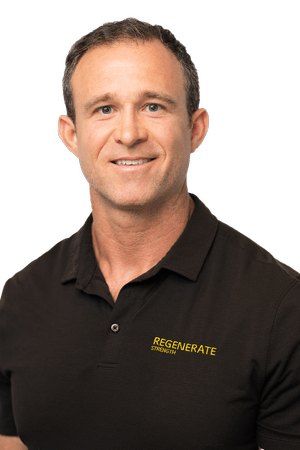
Coach Dave Downey
Owner & Head Coach, Regenerate Strength
Strength & Conditioning Coach, Regenerate Health Medical Center